Artificial Intelligence (AI) is no longer a technology reserved for global enterprises. Businesses of every size—from startups and local service providers to established enterprises—are using AI to automate tasks, improve customer experiences, increase productivity, and make better decisions.
However, successful AI adoption isn't about buying the latest AI software. It's about identifying real business challenges, selecting the right solutions, preparing your data, training your team, and measuring results.
This guide explains how to implement AI in your business step by step, helping you create a practical roadmap that delivers measurable value.
Why Businesses Are Investing in AI
Modern organizations face increasing pressure to reduce costs while improving customer satisfaction and operational efficiency. AI helps businesses achieve these goals by automating repetitive work and providing insights that would otherwise take hours or days to uncover.
Some of the most common benefits include:
-
Automating repetitive business processes
-
Improving customer support with AI chatbots
-
Enhancing marketing through personalization
-
Accelerating content creation
-
Predicting sales trends
-
Detecting fraud and business risks
-
Improving employee productivity
-
Supporting data-driven decision making
Businesses that adopt AI strategically can often achieve faster workflows, better customer experiences, and stronger long-term competitiveness.
Step 1: Identify Business Problems Worth Solving
The first step is not choosing an AI tool—it's identifying the problems you want to solve.
Ask questions such as:
-
Which tasks consume the most employee time?
-
Where do delays occur?
-
Which processes generate the highest costs?
-
What customer complaints are repeated most often?
-
Which business decisions rely on manual analysis?
Common AI opportunities include:
-
Customer support
-
Lead qualification
-
Content creation
-
Sales forecasting
-
Inventory management
-
HR recruitment
-
Invoice processing
-
Email automation
Focus on solving high-impact problems rather than implementing AI everywhere at once.
Step 2: Define Clear Business Objectives
Every AI initiative should have measurable goals.
Examples include:
-
Reduce customer support response time by 50%
-
Increase qualified leads by 30%
-
Reduce manual data entry by 80%
-
Improve marketing conversion rates
-
Shorten report preparation time
Clearly defined objectives make it easier to evaluate the success of your AI investment.
Step 3: Assess Your Data
AI performs best when it has access to accurate and organized data.
Review:
-
CRM records
-
Sales history
-
Customer support conversations
-
Marketing analytics
-
Financial data
-
Product information
-
Website analytics
If your data is incomplete or inconsistent, invest time in cleaning and organizing it before implementing AI.
Step 4: Choose the Right AI Use Cases
Different business goals require different AI solutions.
Marketing
AI can help with:
-
SEO content
-
Email campaigns
-
Ad copy
-
Social media scheduling
-
Customer segmentation
Customer Support
AI enables:
-
24/7 chatbots
-
Automated ticket routing
-
Frequently asked questions
-
Customer sentiment analysis
Sales
AI can assist with:
-
Lead scoring
-
Sales forecasting
-
Proposal generation
-
CRM automation
Operations
Businesses can automate:
-
Invoice processing
-
Document management
-
Workflow approvals
-
Reporting
Step 5: Select the Right AI Tools
Consider these factors when evaluating AI platforms:
Ease of Use
Choose solutions that employees can adopt quickly.
Integration
The software should connect with your CRM, ERP, accounting tools, website, and marketing platforms.
Security
Review:
-
Data privacy
-
Encryption
-
Compliance
-
User permissions
Scalability
Ensure the platform can grow alongside your business.
Step 6: Start with a Pilot Project
Avoid deploying AI across the entire organization immediately.
Instead:
-
Select one department
-
Choose one business problem
-
Measure the results
-
Improve the workflow
-
Expand gradually
A pilot project minimizes risk while providing valuable insights.
Step 7: Train Your Employees
Technology alone doesn't guarantee success.
Employees should understand:
-
How AI works
-
When to rely on AI
-
When human judgment is necessary
-
Data privacy responsibilities
-
Quality assurance processes
Encourage teams to view AI as a productivity tool rather than a replacement for their expertise.
Step 8: Measure Success
Track meaningful metrics such as:
-
Time saved
-
Cost reduction
-
Customer satisfaction
-
Revenue growth
-
Employee productivity
-
Lead generation
-
Conversion rates
-
Error reduction
Review these metrics regularly and refine your AI workflows as needed.
Common AI Implementation Mistakes
Many organizations struggle because they:
-
Implement AI without clear objectives
-
Choose tools based on hype
-
Ignore data quality
-
Skip employee training
-
Fail to measure ROI
-
Automate inefficient processes
-
Expect immediate results
Avoiding these pitfalls greatly increases the likelihood of success.
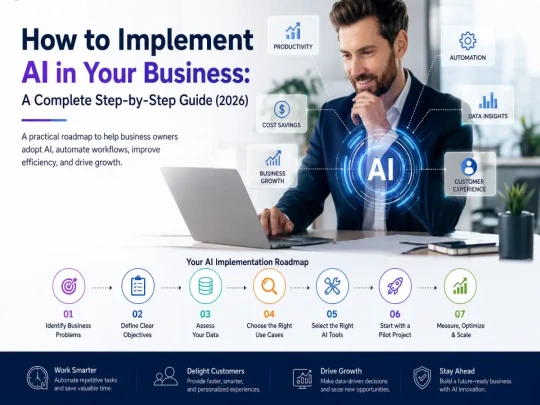
AI Implementation Roadmap
Phase 1: Discovery
-
Identify business challenges
-
Define objectives
-
Assess current systems
Phase 2: Planning
-
Evaluate AI solutions
-
Allocate budget
-
Create a project timeline
Phase 3: Pilot
-
Launch a small-scale implementation
-
Gather feedback
-
Measure performance
Phase 4: Expansion
-
Roll out successful workflows
-
Train additional teams
-
Integrate with existing systems
Phase 5: Optimization
-
Monitor performance
-
Update models
-
Improve processes continuously
How Much Does AI Implementation Cost?
The cost depends on your business size, objectives, and technology stack.
Typical investments include:
-
AI software subscriptions
-
Integration and development
-
Staff training
-
Data preparation
-
Ongoing maintenance
Many cloud-based AI solutions allow businesses to start with affordable monthly subscriptions and scale as they grow.
Is AI Suitable for Small Businesses?
Yes. Small businesses can benefit significantly from AI by automating repetitive tasks, improving customer service, and creating marketing content more efficiently.
A phased approach helps smaller organizations control costs while gaining experience with AI technologies.
Frequently Asked Questions
How long does AI implementation take?
Simple AI projects can be completed within a few weeks, while larger enterprise implementations may take several months depending on complexity and integration requirements.
Do I need a large IT team?
Not necessarily. Many modern AI platforms are designed for business users with minimal technical expertise. More advanced projects may require support from developers or implementation partners.
Can AI work with existing business software?
Yes. Many AI tools integrate with CRM systems, accounting platforms, email services, project management software, and cloud applications through APIs and automation platforms.
How do I measure AI success?
Measure outcomes against your original business objectives. Common KPIs include productivity improvements, cost savings, customer satisfaction, lead generation, and revenue growth.
Final Thoughts
Implementing AI is a strategic business decision rather than a one-time technology purchase. The most successful organizations begin with clearly defined goals, focus on solving real operational challenges, and scale gradually based on measurable results.
Whether you want to improve customer support, automate repetitive processes, enhance marketing, or gain deeper business insights, a structured implementation plan will help you maximize the value of AI while minimizing risks.
Businesses that embrace AI thoughtfully today will be better positioned to adapt, compete, and grow in the years ahead.